The Tabakgasse PolyhedronA Tabakgasse-poliéder
A tetradecahedron from the truncated cube, and the Eternal Flame of the Dohány Street Synagogue
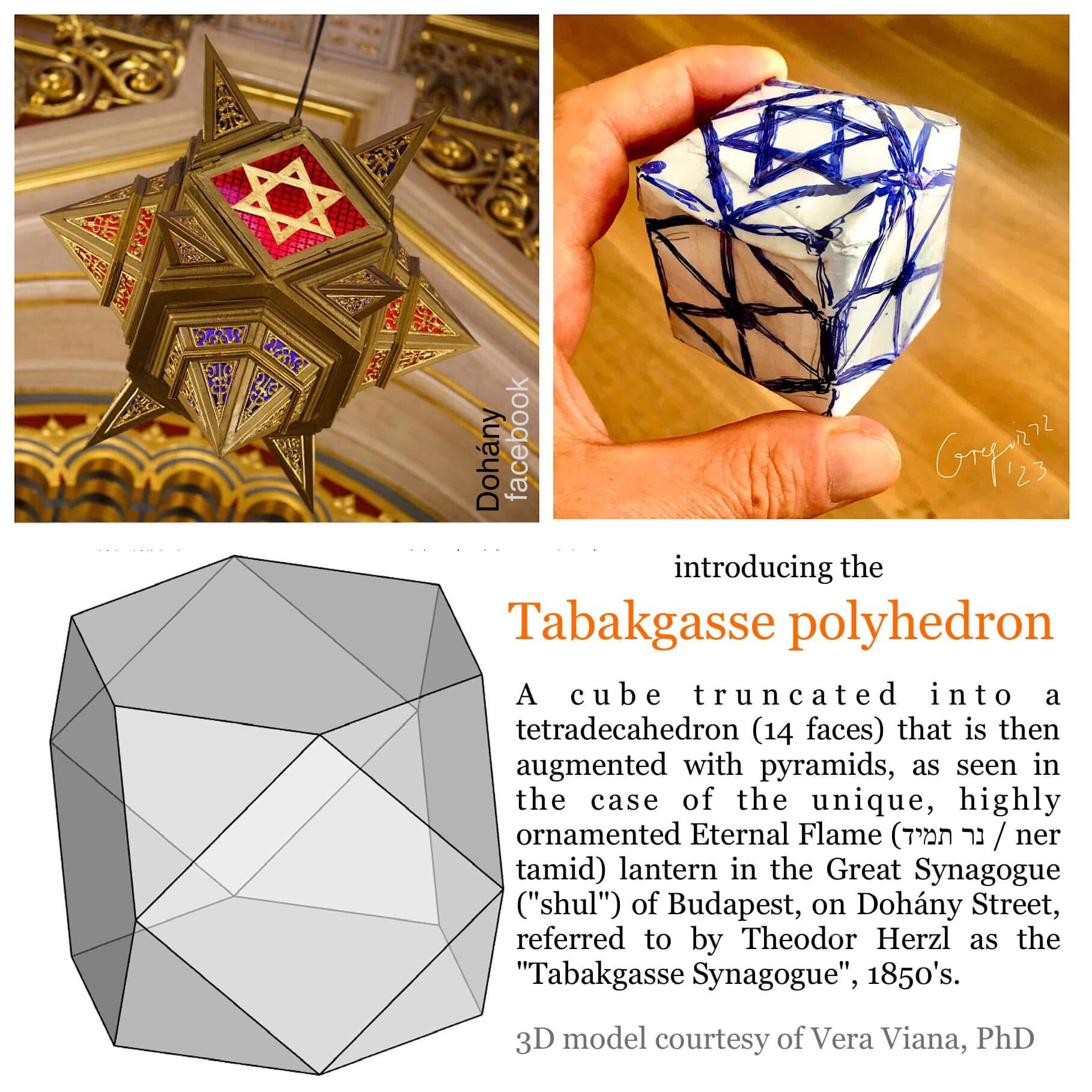
by Grego (Földvári Gergely)
Abstract
Above the bimah of the Great Synagogue on Dohány Street in Budapest hangs an ornamented Eternal Flame — ner tamid — whose lantern is a star polyhedron. Its core is a cube truncated in an unusual way: a tetradecahedron of 14 faces — 2 squares, 4 hexagons and 8 triangles — on which twelve pyramids are raised, with a David star set into each of the two squares in place of a pyramid.
I name this solid the Tabakgasse polyhedron, after the name Theodor Herzl used for the synagogue built beside his birthplace, which today faces the square that bears his name. This paper gives its construction, its measured geometry, and the grounds for thinking it has not been described before.
A Dohány utcai zsinagóga bímája felett függő örökmécses díszlámpás magja egy szokatlan módon csonkolt kocka: 14 lapú tetradekaéder — 2 négyzet, 4 hatszög és 8 háromszög — amelyre tizenkét piramist emeltek, a két négyzetbe pedig Dávid-csillag került piramis helyett. Ennek a testnek adom a Tabakgasse-poliéder nevet.
The solid in rotation
I programmed and filmed two short animations. The first turns the cube-derived Tabakgasse polyhedron. The second turns the truncated-prism version — the one that admits regular hexagons, and so corresponds to the lantern as actually built, on its wooden frame.
The construction
Take a cube of unit edge. On two opposite faces draw a square whose sides join the midpoints of the adjacent edges. On the other four faces inscribe hexagons that are not regular but axially symmetric, each of six isosceles triangles, positioned so that the vertices of their two longer pairs of sides meet the vertices of the squares on the adjacent faces, while their shorter pairs of sides lie along the cube's edges. Then truncate the cube from the sides of the squares, towards the corner being cut off, along the longer sides of those hexagons.
The most remarkable aspect of it, to my mind, is that the construction needs no ruler and no calculation — only halving, cutting and logic. The squares are fixed by the edge midpoints. And since it is impossible for a regular hexagon to have both its vertices and its side midpoints coincide with the cube's edge midpoints, one must use the hexagons that are the most regular available: those built from isosceles triangles whose base and height are both given, which fixes the cutting plane exactly.
The regular hexagon in the lantern itself
Two facts sit close together and can look contradictory, so it is worth stating the difference plainly. The hexagonal face of the polyhedron cannot be regular — that is what the paragraph above proves. But in the lantern as built, the framed wooden base beneath each hexagon lifts the pyramid clear of the truncated cube face, and on that raised frame the pyramid does stand on a genuinely regular hexagonal base. The impossibility belongs to the inscribed hexagon; the regularity belongs to the carpentry above it.
The measured solid
The construction fixes the truncation exactly: the four edges perpendicular to the two square faces are cut at one quarter of their length from each end. All figures are for a cube of unit edge.
| Face | Sides | Area | Perimeter |
|---|---|---|---|
| 2 squares | √(1/2) | 1/2 | 4√(1/2) |
| 8 triangles | √(1/2), √5/4, √5/4 | 0.153093 | 1.825136 |
| 4 hexagons | √5/4 (two pairs), 1/2 (one pair) | 3/4 | √5 + 1 |
The triangles have heights √3/4, 0.547723 and 0.547723, and angles 78.463°, 50.768° and 50.768°. The squares' two diagonals are both exactly 1. The hexagons' three main diagonals — those joining opposite vertices through the centre — are 1, √5/2 and √5/2; the remaining six measure √13/4.
| Stage | Vertices | Edges | Faces | Euler |
|---|---|---|---|---|
| truncated cube | 16 | 28 | 14 | 2 |
| with 12 pyramids, as in the lantern | 28 | 76 | 50 | 2 |
| completely augmented | 30 | 84 | 56 | 2 |
A solid that houses a tetrakis hexahedron
The truncated solid is a hull for a tetrakis hexahedron, and the relation is exact. Taking the tetrakis hexahedron in its canonical proportions — a cube bearing a pyramid of height one quarter of the edge on each face — the largest that fits has a cube edge of exactly two thirds of the original. At that size its six apexes reach the centres of the six original cube faces, so each touches the middle of one of the two squares or one of the four hexagons, while its eight cube corners sit at one sixth and five sixths along each axis, clear of all eight cutting planes.
On the question of novelty
The Tabakgasse polyhedron is not a Johnson solid, and could not be: the Johnson enumeration admits only solids all of whose faces are regular polygons, while here the triangles are isosceles and the hexagons irregular. For the same reason it appears in no other standard catalogue, since those — Platonic, Archimedean, Catalan, Johnson, the uniform and star polyhedra, the deltahedra — enumerate only regular-faced or uniform solids. Its absence from them is therefore expected, and on its own proves nothing.
Searching the standard families and the literature turns up no convex solid with this face set: two squares, four hexagons, eight triangles, sixteen vertices, twenty-eight edges. The nearest named solids are the truncated cube (six octagons, eight triangles) and the truncated octahedron (eight hexagons, six squares), and neither is this one.
More telling than any search: three specialists in polyhedral geometry each made an illustration or model of this solid, and each reported never having encountered it before — Vera Viana, who made the 3D model; Dr Lajos Szilassi, discoverer of the Szilassi polyhedron; and the late Sándor Kabai (1946–2024), whose illustrations appear throughout the paper, and some of whose last works are presented in it.
I ask anyone who knows of the existence of such a lantern, or of one structurally very similar, to be so kind as to send me information or a picture.
Related work
Star Face takes the same concern with symmetry and counting onto Escher's solid, and cites the Tabakgasse polyhedron among its related works. See also The English Cube and Metatron Numbers, The VIO Formula and Coefficial Divisibility.