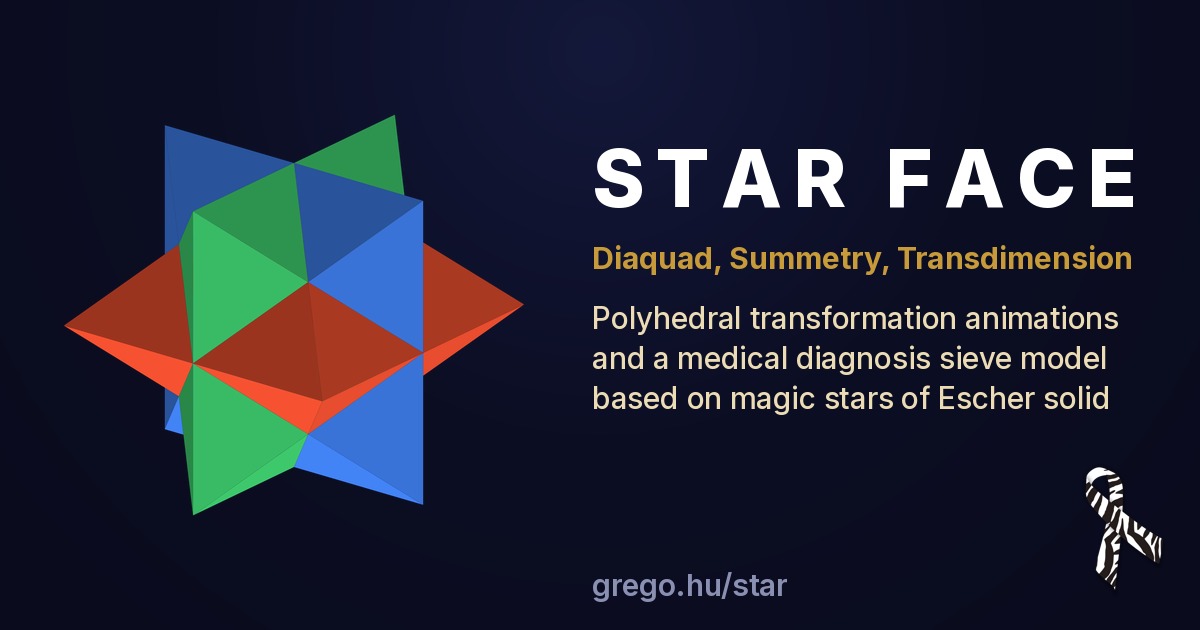
STAR FACE
Diaquad, Summetry, Transdimension
A polyhedral sieve model for medical diagnostics
When you hear hoofbeats, think of horses, not zebras.
— a medical-school diagnostic principle, after T. E. Woodward
Abstract
Bolt, Eggleton and Gilks defined the magic hexagram in 1991. This book takes that definition more broadly and mounts the hexagram on a concave polyhedron that tiles space: Escher's solid, the stellated rhombic dodecahedron, seen also as the invaginated cuboctahedron and as the compound of three flattened octahedra. Its forty-eight faces, read through the star, are the subject.
Three sieves — equilibrium, unambiguity and reliability — reduce a factorial numbering larger than the atom count of the Solar System to a bounded landscape. Its full census is 6,223,974 pyramid-magic numberings, with a proven ceiling of fourfold masking, a floor of five distinct readings, and exactly one deepest fold. The structure is then put forward as a candidate vocabulary for one of medicine's oldest problems: hearing hoofbeats and deciding whether to look for a zebra.
Why Escher's solid, and why the hexagram
The solid casts three orthographic projections, all achiral polygons with their own rotational symmetry:
| Projected polygon | Triangular faces | Projections | Rotational symmetry |
|---|---|---|---|
| square | 16 | 6 | 90° |
| hexagram | 12 | 8 | 60° |
| decagon | 16 | 12 | 180° |
Only the hexagram can cover the whole realm. Four disjoint hexagram projections, their viewing axes restricted to one inscribed tetrahedron, show all forty-eight faces exactly once. No set of squares or decagons ever reaches forty-eight. The hexagram alone tiles the whole realm.
The sieves
First: equilibrium
A grouping survives if some numbering of the twelve star faces by the values one to twelve makes all its groups share one magic sum. The test is plain arithmetic: the values total 78, so a partition into n groups can balance only when 78 divides evenly by n. Four groups of three would need 19.5, and twelve single faces 6.5 — both impossible, both sieved out. The survivors balance at 13, 17 to 22, 26, 32 or 33, and 39. No constant is favoured; 26 is simply where two of the shapes happen to land.
This balance arising from the symmetry itself is what the author names summetry — and notes, in passing, that sieve pronounced in his native Hungarian is szív, heart.
Second: unambiguity
Six families survive the first sieve, three of them overlap covers in which a face is shared between groups and so carries two memberships at once. The second sieve removes every grouping with overlaps, so each face belongs to exactly one group. Only partitions survive: three families, balancing at 13, 26 and 39.
Third: reliability
The third sieve asks whether some numbering makes all twelve outer-apex pyramids — the pyraquads — sum alike. Necessarily to twenty-six, since the twelve pyramids tile all forty-eight faces and 12 × 26 = 4 × 78. The working scope is the four disjoint stars, C(35, 4) = 52,360 combinations up to the solid's symmetry: 8,366 with all twelve diaquads distinct, and 43,994 that repeat one.
The masking landscape
When two or more pyramids carry the same four values they coincide in a mask — a place where a rare reading can hide behind a look-alike, a zebra behind a horse. A pyramid whose quadruple is unique is a clear reading. Two bounds hold, both proven:
- Ceiling. Every value sits on exactly four of the forty-eight faces, so no reading is masked more than fourfold — and fourfold is reached.
- Floor. The twelve pyramids never collapse below five distinct readings. The deepest fold, the (4,0,1) shape, is reached exactly once up to the solid's symmetry: the singularity.
- A clear reading exists for every combination but one. Only #4366 = [5,8,17,21] never reads fully apart — the albino end.
- The lone quad is rare, not impossible, occurring on exactly three combinations. There is no five-pair gap: the (5,0,0) shape occurs nine times.
The full census
| Shape | Reading-shape | Distinct reads | Numberings | Share |
|---|---|---|---|---|
| (0,0,0) | all clear | 12 | 3,538,104 | 56.85 % |
| (1,0,0) | one pair | 11 | 2,079,465 | 33.41 % |
| (2,0,0) | two pairs | 10 | 505,208 | 8.12 % |
| (3,0,0) | three pairs | 9 | 56,916 | 0.91 % |
| (4,0,0) | four pairs | 8 | 3,013 | 0.048 % |
| (5,0,0) | five pairs | 7 | 9 | 0.0001 % |
| (6,0,0) | six pairs | 6 | 91 | 0.0015 % |
| (0,1,0) | one triple | 10 | 21,287 | 0.342 % |
| (1,1,0) | pair + triple | 9 | 14,982 | 0.241 % |
| (2,1,0) | two pairs + triple | 8 | 4,132 | 0.066 % |
| (3,1,0) | three pairs + triple | 7 | 160 | 0.0026 % |
| (0,2,0) | two triples | 8 | 198 | 0.0032 % |
| (1,2,0) | pair + two triples | 7 | 314 | 0.0050 % |
| (0,3,0) | three triples | 6 | 78 | 0.0013 % |
| (0,0,1) | lone quad | 9 | 3 | < 0.001 % |
| (1,0,1) | pair + quad | 8 | 8 | 0.0001 % |
| (2,0,1) | two pairs + quad | 7 | 3 | < 0.001 % |
| (4,0,1) | four pairs + quad | 5 (lowest) | 1 (singularity) | < 0.001 % |
| (1,1,1) | pair + triple + quad | 6 | 2 | < 0.001 % |
Dudeney's ceiling, and the diaquad star
A large-scale supercomputer search confirmed the unambiguity sieve's verdict: Dudeney's classical magic-star numbering can never make all twelve pyramids magic at once, so it admits at most ten. Where the classical construction falls short, the diaquad numbering reaches twelve — and does so by symmetry rather than by search. Its three groups of four lie along the diagonals of the solid's three principal symmetry planes, so the pyramids sum to twenty-six by construction, with no number used twice. A magic earned from the symmetry of the form, not imposed upon it.
With thanks to Dániel Erdély and Gergő Kiss, to Lajos Szilassi, and to the HUN-REN Cloud Team at the Wigner Research Centre for Physics.
Reading the zebra
Let each of the twelve pyramids stand for a diagnostic reading. A mask is a condition wearing a common look-alike's face. The landscape then says three things at once: a clean, fully distinct reading exists for every combination but one, so the zebra can almost always be isolated; masking is always possible, so the zebra can always be made to hide; and the heaviest mask cannot appear quietly, since at its deepest it leaves no clear reading at all — so the gravest case forces itself, eventually, into the open.
The book works this through with Addison's disease, where the early signs are vague, the picture ordinary, and the distinct reading is on the skin.
Related works and spin-offs
- Coefficial Divisibility — multimorphism, transdimension and the folklore result that 26 is the only integer wedged between two perfect powers: the same twenty-six that is this model's magic sum.
- The VIO Formula — a cube's edge times its body diagonal over its face diagonal equals the diameter of its largest inscribed circle.
- The English Cube and Metatron Numbers — the twenty-six letters at the cube's twenty-six characteristic points.
- Summetry carried onto the Platonic solids; the GooglyCube puzzle object; OEIS contributions including A387889, A387890 and A389262; the hectoquads and squared-square work; the gematria of magic sum 26; and the Tabakgasse polyhedron of the Dohány utca synagogue lantern.
Escher's solid recurs across the sciences: Yoshimoto's pair that folds into a cube, now at the Museum of Modern Art; Villeponteau's spacetime lattice; Vangelatos and colleagues on mechanical metamaterials; Pan and colleagues on DNA-origami nanoparticles.
The interactive companion
The animations, the orbitable stars — bright, masked, phantom and albino — and the CUBE 2 ESCHER transformation series live at grego.hu/star, where the book itself opens from the centre star.