Coefficial Divisibility
Multimorphism, Transdimension and Singularity
26 is the only integer directly sandwiched between perfect powers.
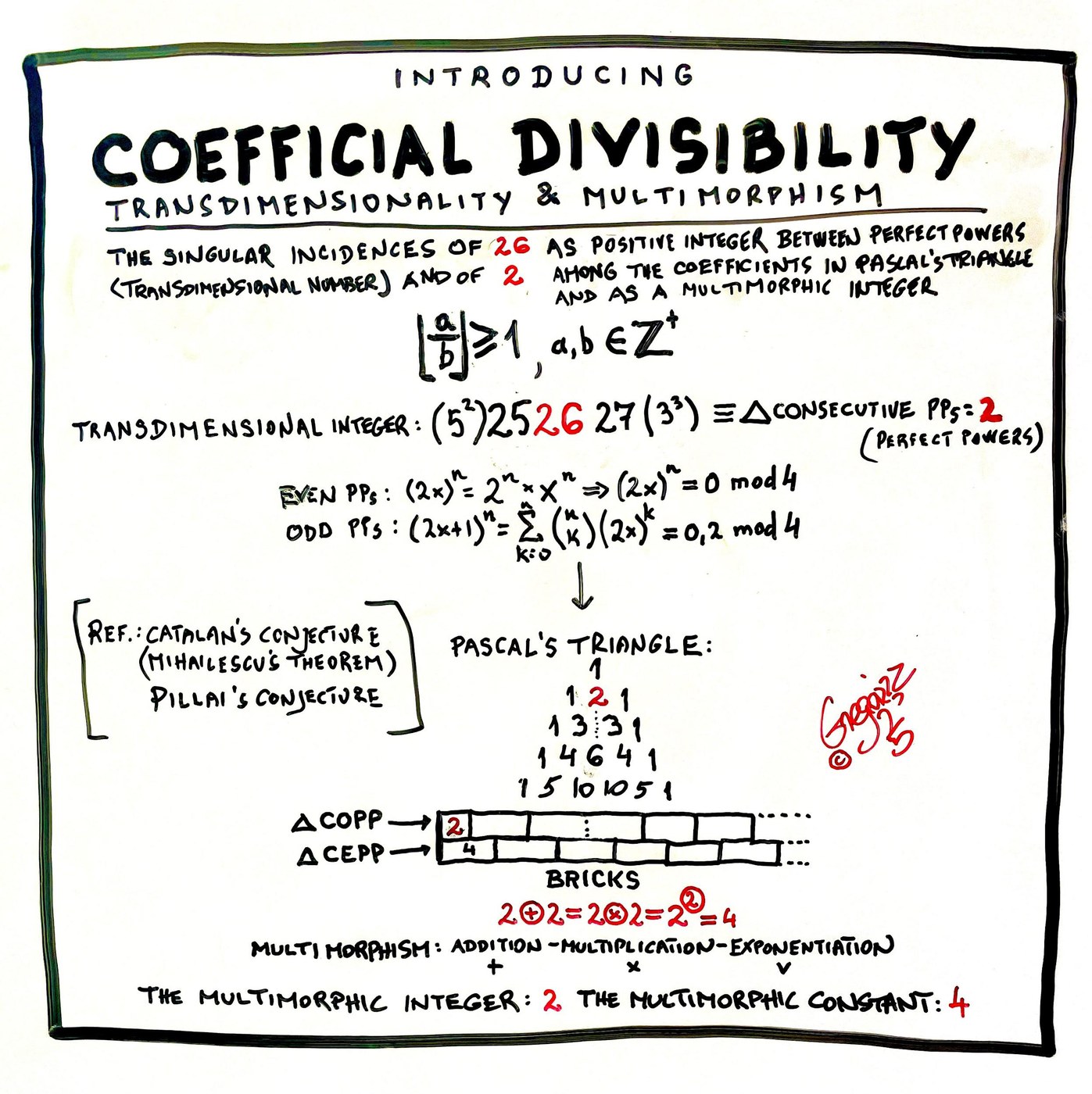
by Grego Gergely Földvári
Exceptio probat regulam (de rebus non exceptis)
Abstract
My intention is to provide fresh ideas and a clearcut approach towards a proof for a famous “folklore” problem in mathematics, congruent to the case of integer 2 in Pillai's conjecture, namely and simply put as 26 is the only integer directly sandwiched between perfect powers, while introducing the perhaps novel concepts of coefficial divisibility, multimorphism and transdimension, all in the context of singular incidence.
The methods outlined here can be a kind of complement to research on Catalan's conjecture (a.k.a. Mihăilescu's theorem), while the juxtaposition of the concepts of singular incidence, consecutive perfect powers of uniform parity, the binomial theorem, Pascal's triangle, coefficial divisibility, integer multimorphism and transdimensionality may hold valuable points towards further partial or full proof attempts, or significantly simplifying existing proofs related to both Catalan's conjecture and Pillai's conjecture in number theory.
1. Restatement of the “sandwiched 26 singular incidence”
In the infinite sequence of integers, any integer's two immediate neighbours have the same parity and always differ by 2. It is therefore trivial that the statement 26 is the only integer directly sandwiched between perfect powers can be restated as congruent to:
In the infinite sequence of perfect powers an where a, n > 1, there is a singular incidence of 2 being the difference between any consecutive (adjacent) perfect powers.
2. Divisibility and isolation by parity
The difference between any pair of consecutive perfect powers of uniform parity and polarity will always be divisible by 4, either without remainder or with a remainder of 2.
Even perfect powers
Written as (2x)n with x ≥ 1 and n ≥ 2, these always differ by at least 22 = 4, because (2x)n = (2n)(xn) has a minimum value of (22)(12) = 4, and (2n)(xn) always evaluates to some nonzero (xn) multiple of (2n), which is always a multiple of 4. Hence:
(2n+p)(xn+q) − (2n)(xn) ≡ 0 mod 4
for which 2 is not a valid value. Therefore 2 cannot be an element in the infinite sequence of first differences of consecutive even perfect powers, and there exist no integers neighboured on both sides by even perfect powers.
Odd perfect powers
Written as (2x+1)n with x ≥ 1 and n ≥ 2, these expand by the binomial theorem to Σ(k=0, n) C(n k) (2x)k, where (2x)k always produces values that either contain 2 or contain 2 plus some nonzero multiple of 2. The two unit coefficients, the first and last terms of the expansion, always add 1 — ensuring odd parity — and some multiple of 4 respectively, while the inner coefficients add further products and exponentials of 2.
Subtracting such an odd perfect power from the larger consecutive one therefore gives an even number — the 1's cancel out — that is either 2, the smallest element and conjectured singular incidence, or 2 plus a multiple of 4.
As bases and exponents increase the differences generally grow, though they can fall back. The lowest fallback value found by extensive computation is 8 in the even cases and 10 in the more relevant odd cases. I therefore conjecture that 2 is a singular incidence and 26 is the only number directly neighboured by perfect powers. As part of an informal collaboration, a computer program written and run in 2024 by William Heyman (USA) confirmed this result in the range 1 to 1558!, an integer of 4,300 digits.
Coefficial divisibility
The concept refines classical definitions of divisibility by excluding trivial or non-meaningful results, admitting only those where division implies meaningful allocation — a quotient of at least 1:
- 8 ÷ 4 = 2 with r = 0: valid
- 10 ÷ 4 = 2 with r = 2: valid
- 2 ÷ 4 = 0: invalid, the quotient is 0
- 3 ÷ 4 = 0: invalid, the quotient is 0
Unlike four or more, merely two pebbles cannot be divided and shared fairly among four boys for water skimming.
First differences of consecutive odd perfect powers
2, 4, 18, 18, 38, 10, 12, 100, 106, 128, 30, 148, 154, 166, 198, 260, 138, 216, 26, 28, 270, 248, 284, 546, 524, 506, 574, 652, 250, 726, 94, 568, 170, 548, 954, 1000, 638, 180, 890, 412, 888, 674, 908, 1170, 1262, 1036, 782, 1048, 1590, 734, 252, …
First differences of consecutive even perfect powers
4, 4, 16, 20, 28, 24, 36, 68, 40, 56, 32, 100, 92, 168, 100, 152, 48, 104, 356, 100, 116, 496, 104, 80, 8, 144, 368, 316, 28, 732, 648, 784, 252, 704, 184, 828, 964, 200, 832, 396, 1148, 728, 732, 1208, 656, 112, 932, 804, 196, 748, 804, 316, 764, …
All elements in a combined and ordered infinite sequence of these first differences are coefficially divisible by either 4 without remainder or by 4 with a remainder of 2 — except the smallest, first and perhaps only element of value 2, a singular incidence corresponding both to the only singular incidence of an integer in Pascal's triangle and to the singular incidence of integer multimorphism.
3. Conclusion
The only known case when an element of that combined sequence takes the value 2 is at the very beginning, when base and exponent are lowest and one odd perfect power is followed by another with no even perfect power between them:
(2x+1)m > (2y+1)n, where x, y ≥ 1 and m, n ≥ 2
(2×1+1)3 = 27 > (2×2+1)2 = 25, 27 − 25 = 2
Note that although (2×1+1)2 = 9 and (2×1+1)3 = 27 satisfy the inequality constraint, (2×2)2 = 16 lies between them, so they are not consecutive odd perfect powers without an even perfect power between them.
4. Singularities of integer 2, and multimorphism
In addition to the invariant 2 in the Euler formula for simple polyhedra, the singular incidence of 2 among the coefficients of the expanded binomial theorem — the rows of Pascal's triangle — corresponds with its singularity as the multimorphic integer, and with the singular incidence of 2 as the difference between consecutive perfect powers. This is why I call 26 the transdimensional number: it sits between a square and a cube.
Definition of multimorphism
An integer a is multimorphic if addition, multiplication and exponentiation applied to a with itself all yield the same result:
a + a = a × a = aa
The only integer satisfying this is 2: 2 + 2 = 4, 2 × 2 = 4, 22 = 4. Thus 2 is the unique multimorphic integer, and 4 is the multimorphic constant — the common output of the triadic self-operation. Interestingly, the multimorphic constant 4 and the multimorphic integer 2 are the very divisor and remainder values of the divisibility lemma above.
5. Analogy: the brick wall
Coefficial divisibility is analogous to a traditionally built brick wall where one row starts with a full brick and the adjacent row with a half-brick. The row starting with a full brick is the sequence of first differences between consecutive even perfect powers (ΔCEPP); the row starting with a half brick is the sequence for consecutive odd perfect powers (ΔCOPP). Without proper tools to divide a brick, no wall starting and ending in a straight line could be built using the placement proven to give optimal stability. Coefficial divisibility may be such a tool. After all, that cut-off half-brick will come real handy, if the row that begins with its other half is ever to be completed.
6. Coefficial divisibility and Pillai's conjecture
The approach rests on a simple rule — defining 1 as the minimal value for a quotient, invalidating zero — which aligns with both human cognitive development and formal mathematical thought. Besides describing the exceptional property of the conjectured singular incidence of 2 among the differences between consecutive perfect powers, the methods may open the way for further proofs, and especially for simplifying existing ones, related to the finite incidences of integers other than 2 in Pillai's conjecture.
In memory of Subbayya Sivasankaranarayana Pillai (5 April 1901 – 31 August 1950).
References
- Weisstein, E. W.: Catalan's conjecture, MathWorld
- First differences of consecutive perfect powers, OEIS A053289
- Perfect powers, OEIS A001597
- Catalan's conjecture, Wikipedia
- Ghannouchi, J.: A proof of Pillai conjecture, 2012, hal-00698687v22
- Bennett, M. A. and Siksek, S.: Differences between perfect powers: prime power gaps, Algebra and Number Theory Vol. 17, 2023/10, DOI 10.2140/ant.2023.17.1789
Related work
The English Cube and Metatron Numbers · The VIO Formula. For the author's OEIS® contributions please visit the author’s OEIS® contributions.