VIO Formula
Cube edge times body- over face-diagonal equals the diameter of the largest inscribed circle.
Hungarian VIO TÉTEL / VIO KÉPLET Slovak VIO VETA
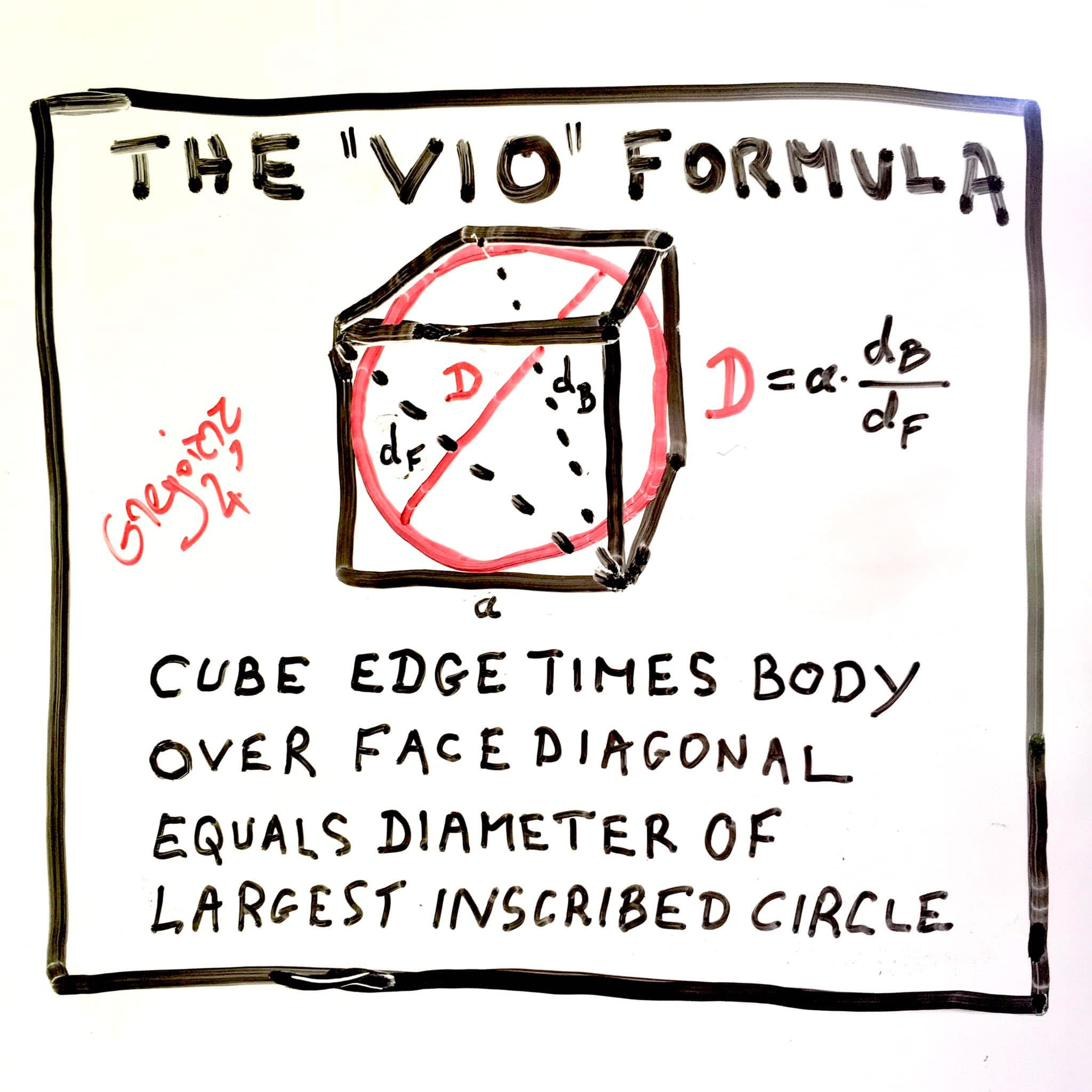
D = a · db df
by Grego (Gergely Földvári)
Abstract
The VIO formula is first of all a sentence. Cut a cube through the midpoints of six of its edges and the section is a regular hexagon, the largest that fits; the circle inscribed in it is the largest circle the cube will hold. Its diameter is the cube's edge multiplied by the body diagonal divided by the face diagonal — and it is longer than the edge itself, which is the part that surprises. No square roots are needed to state any of it — they appear only in the proof below. A practical consequence: a ring is held by a box narrower than the ring itself.
In the original Hungarian: Kocka él szorozva test-, per lapátló egyenlő legnagyobb beírt kör átmérő. In Slovak, translated by Ladislav Palmai: Hrana kocky krát uhlopriečka telesa delená uhlopriečkou steny sa rovná priemeru najväčšieho vpísaného kruhu.
The name
V represents the two diagonals, I the edge, and O the largest inscribed circle of the cube. Vio in Latin means “I go” or “I travel”, from the verb viare; the noun is via.
In Hungarian the relationship is called VIO tétel or VIO képlet, and in Slovak VIO veta.
A loss in algebra can be a discovery in geometry.
The proof
Among the infinitely many planes along which a cube can be cut in half, four touch its surface at the midpoints of six edges. Each is defined by the midpoints of two neighbouring edges together with the centre of the cube, and outlines a regular hexagon whose six vertices all sit at edge midpoints. These hexagons are the largest that fit in a cube, since their whole perimeter lies on the cube's surface; and so the circles inscribed in them are the largest circles the cube will hold.
The radius x/2 of that incircle is the height of the equilateral triangle whose sides are half the face diagonal. By Pythagoras:
(x/2)2 + (√2/4)2 = (√2/2)2 → x = √3 / √2
Since a√3 is the body diagonal and a√2 the face diagonal of a cube of edge a, multiplying numerator and denominator by a leaves the value unchanged while rewriting it as x = a√3 / a√2 — a fraction of the body diagonal over the face diagonal. Multiplying both sides by a preserves the equality, so the diameter scales linearly with the edge.
The extension: the largest inscribed triangle
The largest triangle that fits in a cube is the equilateral one whose three vertices are corners of the cube, each pair joined by a face diagonal, so its side is a√2. The median of an equilateral triangle of side s is s√3/2, which gives a√6/2 — exactly the diameter above.
The diameter of the cube's largest inscribed circle is equal to the median of the cube's largest inscribed triangle, which is equal to the edge times the body-, over the face-diagonal.
The ultimate extension: the largest inscribed square
The largest square lying entirely within a unit cube is not one of its faces but a tilted square of area 9/8, hence of side 3√2/4 ≈ 1.0606602, the square at the heart of Prince Rupert's problem. Its diagonal is exactly 3/2, and 3/2 is precisely the square of √6/2.
The diagonal of the cube's largest inscribed square is equal to the square of the diameter of the cube's largest inscribed circle.
| Figure inscribed | Quantity | In terms of D | Unit cube |
|---|---|---|---|
| circle | diameter | D = a · db/df | √6/2 = 1.2247449 |
| triangle | median | D | √6/2 = 1.2247449 |
| square | diagonal | D2 | 3/2 = 1.5 |
| square | side | D2/df | 3√2/4 = 1.0606602 |
A wedding ring in a box, an optical cable in a lorry
The formula has a practical face, and it is the one worth remembering. A circle 22.47 per cent wider than the edge of a cubical box will still lie inside that box, because it can be tilted onto the hexagonal plane instead of laid flat against a face. Turned the other way round: to hold a ring of diameter d, a cubical box needs an edge of only √2/√3 · d ≈ 0.8165 d — 18.35 per cent less than the ring is wide.
A wedding ring goes into a box narrower than the ring itself. A coil of optical cable rides in a crate whose side is shorter than the coil is across. For anyone packing, specifying or freighting round goods in square containers, the tilt is worth very nearly a fifth of the box — and the ratio that measures it is the body diagonal over the face diagonal. The number quoted is the cube's; in an elongated container the tilt buys more still.
A meeting with the Metatron Numbers
√6/2 is not a stranger. In The English Cube and Metatron Numbers it appears as the fourth of the eight segment classes, the quarter-cube body diagonal, of which the cube holds 48. The largest circle a cube will contain has a diameter equal to that segment. The two results were arrived at separately and meet at this number.
Publication history
| 19 April 2024 | First shared publicly by the author in the group Polyèdres et particularités mathématiques |
| 19–21 April 2024 | György Birkás: Mateklecke 4351 and 4359, the latter with proof |
| 24 April 2024 | Bridges: Arts and Mathematics |
| 24 April 2024 | Number geometry |
| 25 April 2024 | Slovak version, translated by Ladislav Palmai |
| 12 June 2024 | Extended by the author to the cube's largest inscribed triangle and square |
| 11 May 2026 | First on-line publication, Gondolkodás Öröme Alapítvány — mindenkijon.hu |
Acknowledgements
Special thanks and gratitude to distinguished mathematicians Gyula Obádovics, Lajos Szilassi and Veronika Hámori for publicly acknowledging the VIO Formula's novelty and for congratulating me personally, and a heartfelt thanks to György Birkás for his continued support for my mathematics related endeavors.
For the author’s contributions please visit: OEIS®