XIO RATIOand 26, the Transdimensional Number
Add 26% to the edge of a cube and you about double its volume.
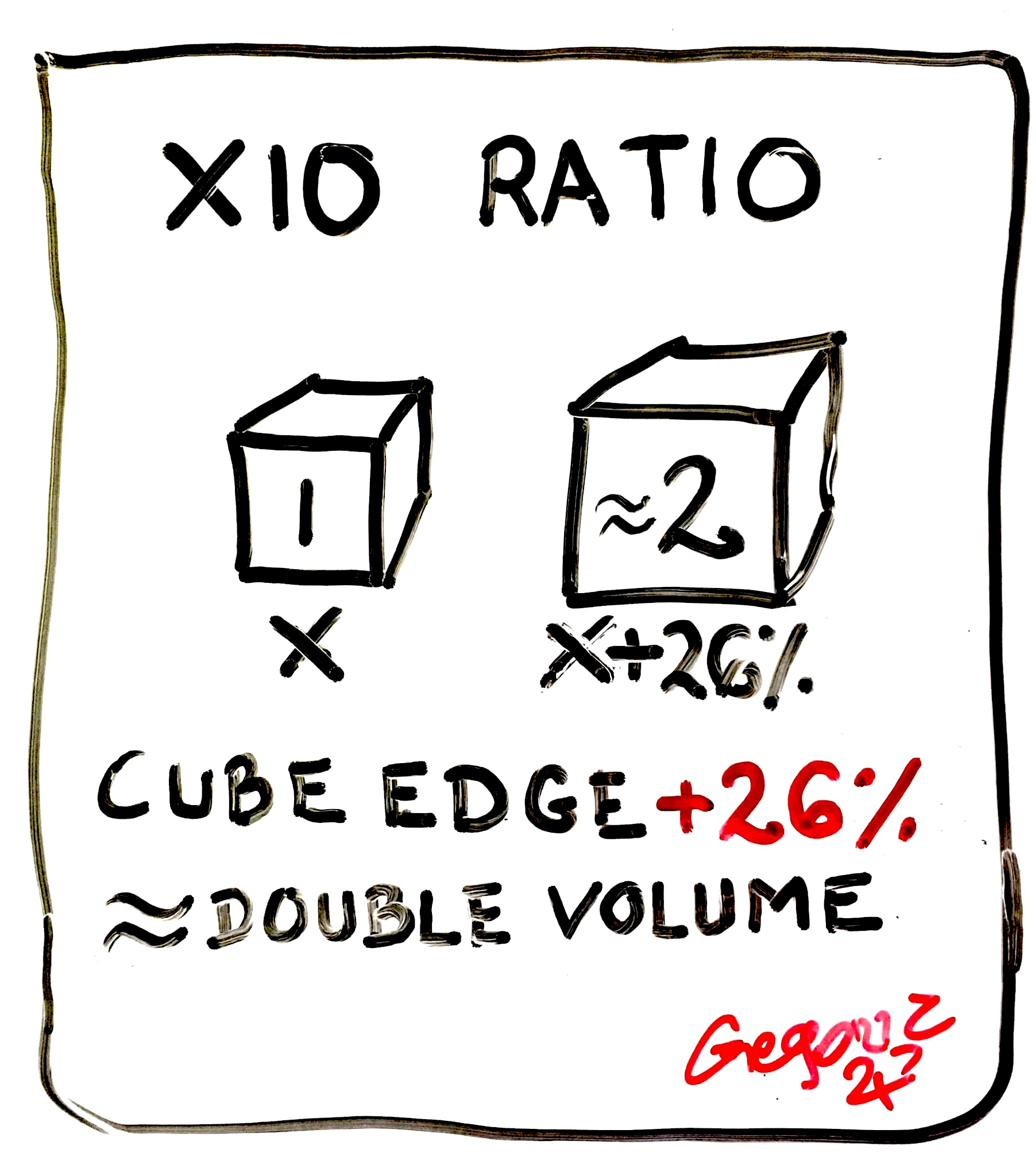
by Grego (Gergely Földvári)
The ratio
Subtracting the edge of a unit cube from the edge of a cube of twice its volume gives an irrational number that rounds to twenty-six hundredths. That is the whole of it.
³√2 − 1 = 0.2599210… ≈ 0.26
I name this the XIO ratio: X for the longer edge of the double-volume cube, I for the edge of the smaller one, and O for the nought in 0.26 — a nought that has a claim of its own, as below. From it follows the XIO formula: a · 1.26 ≈ b, where 2a³ ≈ b³.
How close is it?
Closer than a rule of thumb has any right to be. The rounding loses six thousandths of one per cent on the multiplier, and because the error is cubed it still comes to under two hundredths of one per cent on the volume.
| Value | Error | |
|---|---|---|
| ³√2, the exact multiplier | 1.2599210499 | — |
| 1.26, the rule | 1.26 | +0.0063% |
| 1.26³, the volume it gives | 2.000376 | +0.019% |
| exact increase needed | 25.9921% | — |
| three steps of +26% | 8.0045 | +0.056% on 8 |
| ten steps of +26% | 1025.93 | +0.19% on 1024 |
A second figure worth having: area scales as the square of length, so the same 26% costs only 1.26² = 1.5876 in surface — about 59% more skin for twice the contents. Anyone buying sheet metal, glass, cardboard or paint has just been told something useful.
It is not a fact about cubes
I first put this as a rule for cubes, then for spheres and the regular and semi-regular solids, and for any solid with a cubic determinant in its volume formula. That was too cautious. The rule is universal, and the reason is one line:
volume scales as the cube of any length
Scale every dimension of any shape whatever by a factor k and its volume multiplies by k³. The cube root of 2 is therefore the answer for everything, not for cubes. A teapot 26% taller holds two cups instead of one. A lake 26% wider, deeper and longer holds twice the water. A planet of double the volume has a radius 26% greater; so does a star, and so does the sphere a galaxy's halo occupies. Only similarity matters: the copy must be the same shape, scaled in every direction at once.
Where the rule stops — and why that is interesting
Geometry scales; physics does not. Volume grows as the cube of length while cross-sectional area, which carries weight, grows only as the square. An animal of twice the volume is 26% longer but weighs twice as much on bones only 59% thicker in section — which is why a mouse enlarged to the size of an elephant would collapse, and why an elephant is not a scaled-up mouse. The same square-cube law governs why large ships need disproportionate structure and why a doubled-volume tank needs more than 26% more wall. So the XIO ratio answers the geometric question exactly and the engineering question only as a first estimate.
Why the number is 26
It isn't. The 26 is a consequence of ³√2, and ³√2 does not know about the integer 26. What is striking is that the rounding lands on an integer with independent claims of its own.
26 sits between a square and a cube — the only positive integer with a perfect power either side: 25 = 5² below, 27 = 3³ above. Extend it to all integers and zero joins it, between (−1)³ and 1². That result is the subject of a companion paper, Coefficial Divisibility; here it is enough to note that the nought and the twenty-six in 0.26 are both numbers with this property.
26 is how many times the cube's rotation axes meet its surface: three four-fold axes through the face centres, four three-fold through the vertices, six two-fold through the edge midpoints, each crossing twice — 3·2 + 4·2 + 6·2 = 6 + 8 + 12 = 26. Which is also the count of the cube's characteristic elements, the starting point of The English Cube and Metatron Numbers.
26 is the atomic number of iron, the most abundant element on Earth by mass, body-centred cubic at room temperature and face-centred cubic when hot. And 26 is the gematria of the Tetragrammaton: yod 10, hey 5, vav 6, hey 5. The English alphabet has 26 letters.
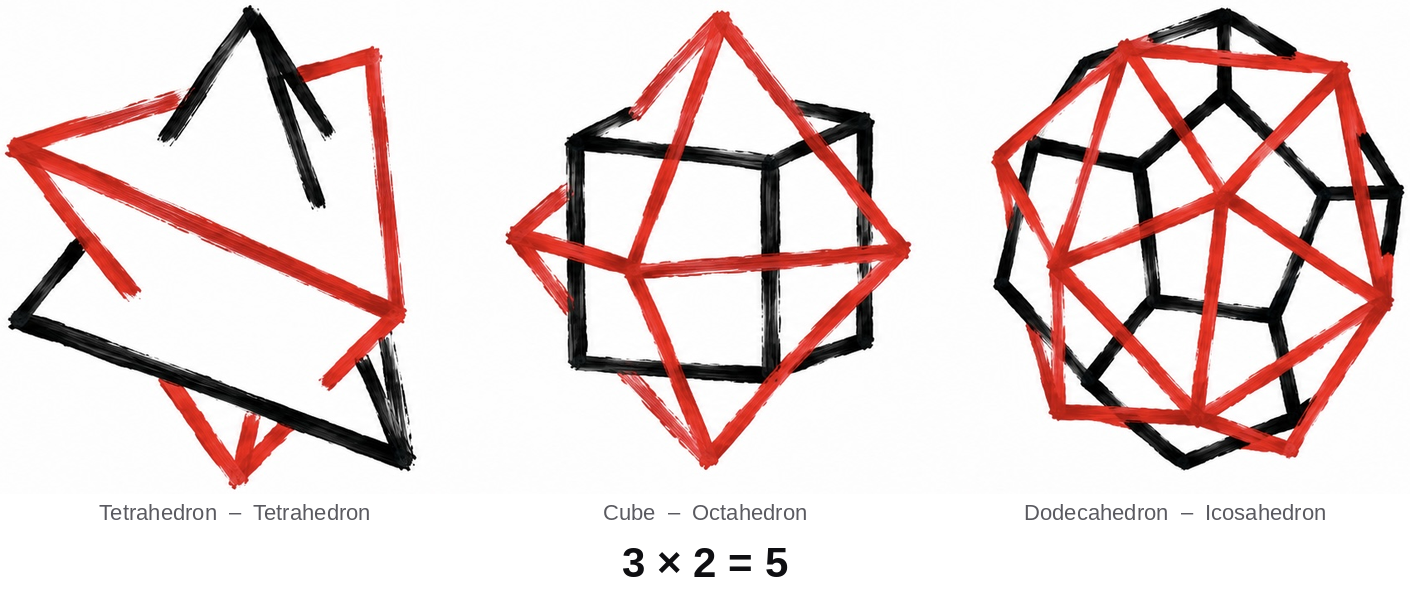
The five Platonic solids as three dual pairs. Join the centres of a solid’s faces and you get its dual: the cube gives the octahedron, the dodecahedron the icosahedron, and the tetrahedron another tetrahedron. Three pairs of two — and five solids, because the tetrahedron is its own dual and fills both places in its pair by itself. Arithmetic that looks wrong and is not, which is rather the business of this paper.
The iron
Of all the twenty-sixes, this is the one that has occupied me longest, and it is in none of my other papers. Iron is element number 26: twenty-six protons in the nucleus and twenty-six electrons around it. What follows is what that number does — in a tomb, in a crystal, in a star, and in the blood.
Beads from the sky
The oldest iron objects known are nine small tubular beads from two burials at Gerzeh in northern Egypt, dated to about 3200 BC, strung into a necklace with lapis lazuli, gold and carnelian. They were not mined: analysis found cobalt and germanium at levels that occur only in meteoritic iron. The metal fell from the sky and was hammered cold into sheets, then rolled into tubes.
Smelting — winning iron from ordinary ore — came roughly two thousand years later, and the reason is a temperature. Iron melts at 1538 °C, far beyond any early furnace; copper melts at 1085 °C. That is why the Bronze Age precedes the Iron Age. The trick, when it came, was to avoid melting altogether: a bloomery furnace reduces the ore to a solid spongy mass which is then hammered — and it was the sky-metal at Gerzeh that taught people to hammer iron.
Once smelting was mastered, iron displaced bronze for a reason beyond hardness: it is everywhere, and it is not poisonous. Rome plumbed its cities in lead. An iron pot adds iron to the food cooked in it, and that is a benefit rather than a hazard — iron is an element the body requires. Only in overload does it harm, which is a different matter from a metal toxic at any dose.
The atom, and a coincidence I am fond of
Iron has 26 protons and, when neutral, 26 electrons, sitting in four shells — layers around the nucleus, each holding only so many:
2 + 8 + 14 + 2 = 26
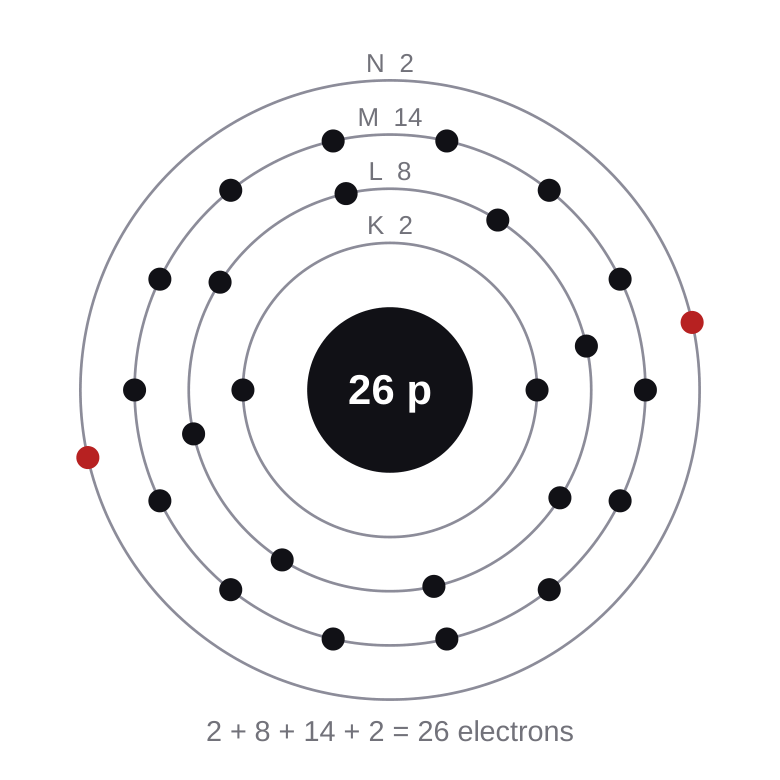
The iron atom. The dark centre is the nucleus: 26 protons (p) and, in the common form, 30 neutrons (n). The four rings are the electron shells, labelled K, L, M and N from the inside out. The two red dots on the outermost ring are the electrons that do iron's chemistry — the ones it lends when it rusts, and when it carries oxygen in the blood.
The radius of an iron atom is 126 picometres. A picometre, written pm, is a millionth of a millionth of a metre: you would need some four million iron atoms side by side to span a millimetre. In the older unit chemists still like, the ångström, which is a hundred picometres, that radius is 1.26 å.
1.26 again — and I want to be honest about what that is. It is a coincidence and cannot be anything else: the metre was defined by people, the ångström is a human convenience, and an atom knows neither. Change the unit and the digits change. The cube root of two, by contrast, is 1.2599210 in every language and every system of measure there has ever been. The two 1.26s are not connected and I will not pretend otherwise. But a paper about adding 26% to an edge, by an author who has spent years on the number 26, may be forgiven for noticing that the atom numbered 26 has a radius of 1.26 units in the scale chemists chose.
Iron is a cube
At room temperature iron's atoms sit in a body-centred cubic lattice: a cube with an atom at each of its eight corners and one more at the very centre. The cube's edge is 286.65 pm, a little over twice the atomic radius. Heat it past 912 °C and the atoms rearrange into a face-centred cubic pattern — corners again, but with an atom in the middle of each of the six faces. Past 1394 °C it returns to body-centred, and at 1538 °C it melts. Both arrangements are cubes: the element carrying the number 26 builds itself, at every temperature at which it is solid, on the shape whose 26 characteristic elements began this whole line of work.
Where the stars stop
A star shines by fusion: light nuclei pressed together into heavier ones, the joining releasing energy. Hydrogen becomes helium, helium becomes carbon, then oxygen, neon, magnesium, silicon. Each step profits less than the last. At iron the profit runs out.
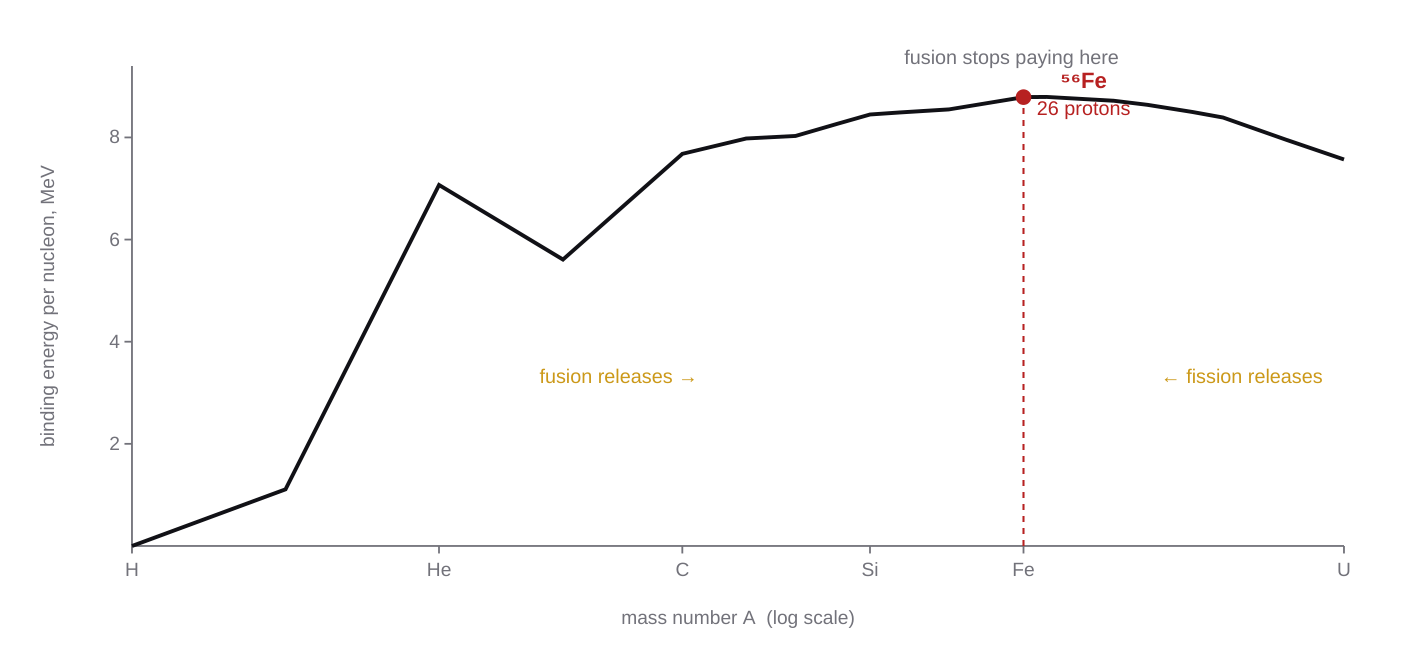
Why fusion stops at iron. The curve is the binding energy per nucleon — nucleon meaning a proton or a neutron, binding energy meaning how tightly the nucleus holds together, measured in MeV, millions of electronvolts. The higher the curve, the more stable the nucleus. Going uphill releases energy; going downhill costs it. Everything left of the peak can profit by fusing, everything right of it by splitting, and at the top — iron — neither pays.
Here is the detail almost everyone gets slightly wrong, textbooks included. Iron-56 is not quite the most tightly bound nucleus there is: nickel-62 holds that record at 8.7945 MeV per nucleon against iron-56's 8.79. What iron-56 has is the lowest mass per nucleon of any nuclide at all. And nickel-62 cannot be reached in quantity by the route stars actually take, because that route — the alpha process — adds helium nuclei four nucleons at a time, and 62 is not a multiple of four.
And nickel's number is 28 protons, but the isotope in question is nickel-62 — which is 26 read backwards. Idle, and I know it. But it comes with something that is not idle: 26 and 62 are the only two-digit integers whose halved digits add up to the difference of those digits. Halve 2 and 6 to get 1 and 3; they sum to 4; and 6 − 2 = 4. The same holds for 62, and for nothing else in the range. The halving is what does the work: a digit with no whole half cannot enter the question at all, so every number with an odd digit is excluded before it starts, and of the twenty two-digit numbers built from even digits alone, only 26 and its reversal satisfy the condition.
So the chain runs to nickel-56, fourteen helium nuclei stacked, which decays to cobalt-56 and then to iron-56, where it settles. Fusing further would consume energy rather than release it. The furnace goes out, the core has nothing left to hold itself up with, and it collapses — a supernova. The ash of that fire, scattered across space, is iron.
From the core of a star to the core of the blood
Iron is, by mass, the most abundant element on Earth. Being dense, most of it sank while the planet was forming, and it is down there still: the core is iron with some nickel, liquid outside and solid at the centre. That liquid iron moves, and moving iron makes a magnetic field — the field that deflects the solar wind and keeps this planet's atmosphere from being stripped away. Mars, whose core cooled, lost its field and then lost most of its air.
And in your blood, at the centre of every haemoglobin molecule, sit iron atoms, each holding one oxygen molecule for the length of a heartbeat and letting it go where it is needed. Red blood is iron chemistry, using those same two outer electrons.
So the number 26 ends the life of a star, is flung out by its death, sinks to the middle of a planet, raises the shield that lets an atmosphere survive, and then carries the breath around the body of everything that breathes. A considerable career for an integer — and none of it numerology. Every step is in the textbooks.
And the letters
Now the part that makes scientists uneasy, and which I claim as an artist's liberty rather than as a finding. The numerical value of the Tetragrammaton — the four-letter name of God in the Hebrew Bible, read right to left as yod, hey, vav, hey, valued by the ancient practice of gematria at 10 + 5 + 6 + 5 — is 26. The English alphabet has 26 letters. The cube has 26 characteristic elements. Iron is element 26.
I do not claim a mechanism. There is none, and anyone offering one should be disbelieved. Gematria assigns values by convention; the alphabet grew by accident; the cube's 26 is a theorem; iron's 26 is a fact of physics. Four unrelated systems, one number. A mathematician is right to call that coincidence, and I would not argue.
But it is the coincidence that set me going. Every paper I have written began with noticing that a number kept turning up where it had no business being, and asking what was actually true around it. The noticing was an artist's; what came of it had to survive arithmetic.
The square, the cube, and the turning
25 is a fact about the plane: a square number, two dimensions multiplied. 27 is a fact about space: a cube, three dimensions. And the third property — the 26 crossings of the rotation axes — is the one you cannot demonstrate without time passing. A square is square at an instant; a cube is cubic at an instant; but a rotational symmetry has to be performed. You must turn the cube to show that it comes back to itself, and turning takes time.
I will not claim this makes the symmetry four-dimensional. It does not: the axes are ordinary lines in space, and the symmetry group is a set of transformations, not of events. But of the three, it is the only one a still picture cannot carry — and if one wants a name for a property that needs duration to be exhibited, time is the honest place to look. That is what I mean by calling 26 transdimensional: it is reached from the plane, from space and from motion, by three unrelated routes.
A note on computers
If you check the sandwiched-26 property with a calculator or a graphing program, be wary of the machine. Rearranged, the condition is x² + 2 = y³, and software will happily offer solutions that are not solutions: x = 27,000 with y = 900 gives 729,000,002 against 729,000,000 — wrong by exactly 2, the very quantity in question.
The true statement is classical and worth citing rather than arguing from scratch: Fermat proved that x² + 2 = y³ has exactly one solution in positive integers, x = 5 and y = 3 — which is to say 25 and 27, with 26 between. The modern proof runs through unique factorisation in the ring Z[√−2].
What it is good for
| Question | Answer by XIO |
|---|---|
| A tank of twice the capacity — how much bigger? | every dimension +26% |
| A box of half the volume — how much smaller? | every dimension −21% |
| Twice the volume — how much more material? | about +59% of surface |
| Eight times the volume? | +26% three times over |
| A thousandfold? | +26% ten times over |
Related work
The sandwiched 26 is treated properly in Coefficial Divisibility. The cube's 26 characteristic elements are the subject of The English Cube and Metatron Numbers. A companion ratio in the cube is The VIO Formula — named on the same pattern, and from which this one takes its X, I and O. All seven papers are listed at grego.hu/papers.