The Rilke Gap
A Rilke-rés · Two probability problems in which the answer depends on who — or what — is choosing
by Grego (Gergely Földvári)
Abstract
A chess puzzle asks for the probability that Black, playing for the two-move mate, wins a bet against an opponent who chooses moves at random. The answer is not one number. If White is a person, the FIDE touch-move rule binds the hand: a player who touches a piece that has a legal move must move that piece. A machine touches nothing, so the rule cannot bind it. The two opponents therefore randomise over different objects — the person over pieces, the machine over moves — and the probabilities part company: 1/110 ≈ 0.909 % for the person, 1579/159600 ≈ 0.989 % for the machine. The machine, which never hesitates, walks into the trap 8.8 % more often. The same discrepancy appears with no chess in it at all: three Jokers hidden in one hand of twelve cards give 25 %, but split as two among ten and one among two they give 35 %. Both cases are instances of a single identity. The gap is named for Rilke, whose tenth sonnet of the second part of the Sonnets to Orpheus sets the Machine that dares to feign spirit against the hesitation of the glorious hand.
The puzzle
“What is the mathematical probability that Fruzsi, playing the dark pieces, wins the bet she has offered Félix — namely that she will deliver checkmate on the second move of the game?”
Taken at face value this is a short exercise. It is not, because the puzzle does not say who, or what, Fruzsi is playing against. White knows the rules and keeps them, and chooses the first two moves at random, with no strategic consideration whatever — otherwise there would be nothing to compute. Fruzsi knows exactly how the two-move mate can be forced. So the probability depends on White's first two moves and on nothing else. The hidden question is what “at random” means, and the answer is not the same for a person and for a program.
The only two-move mate
From the initial position, Black can give checkmate on Black's second move if and only if White's two moves are, in either order, a move of the f-pawn (to f3 or to f4) and the double step of the g-pawn to g4. Black then plays the e-pawn to e5 or e6 and mates with Qh4# — a single check, not a double one. There are exactly eight such games, confirmed by exhaustive search over every legal four-move sequence from the opening position.
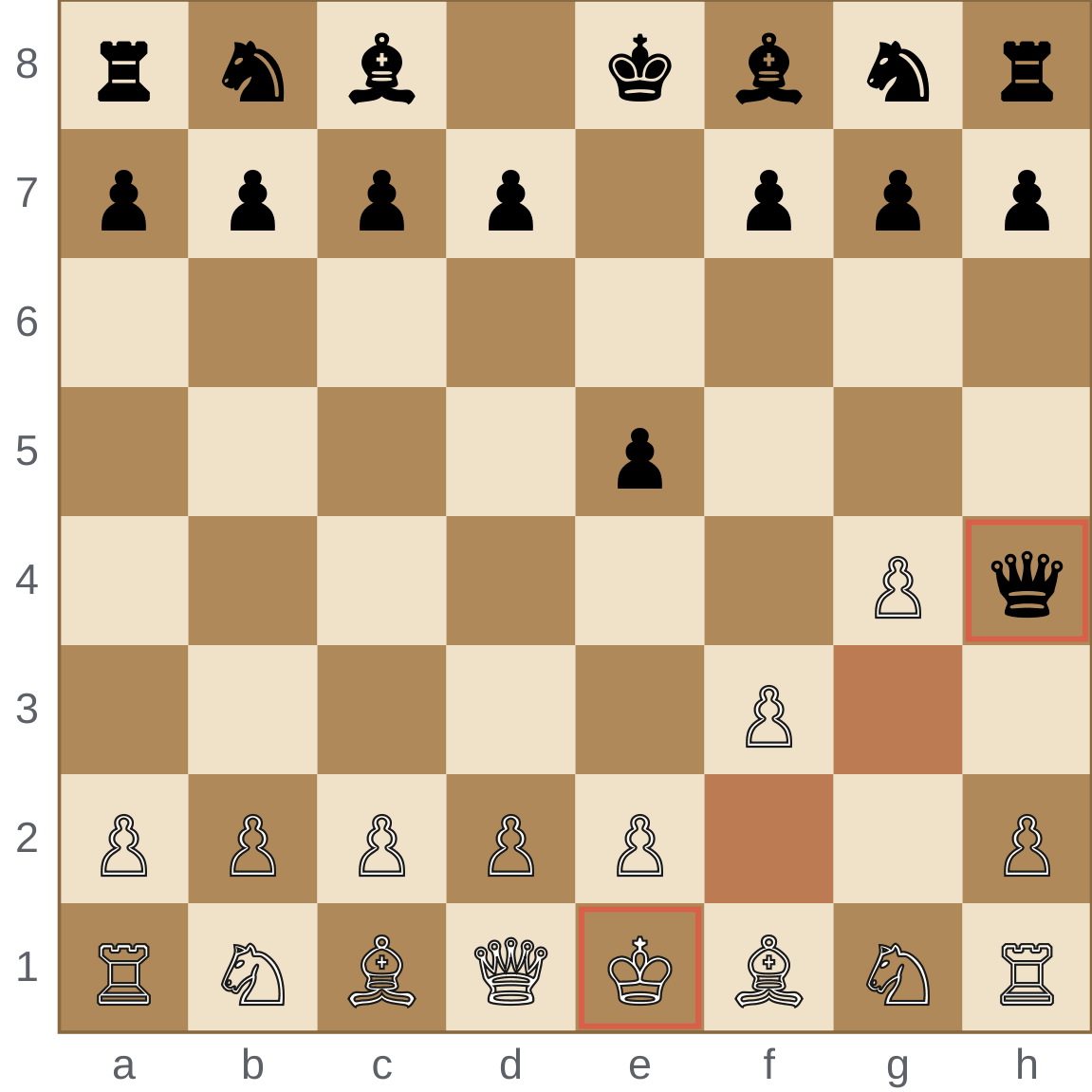
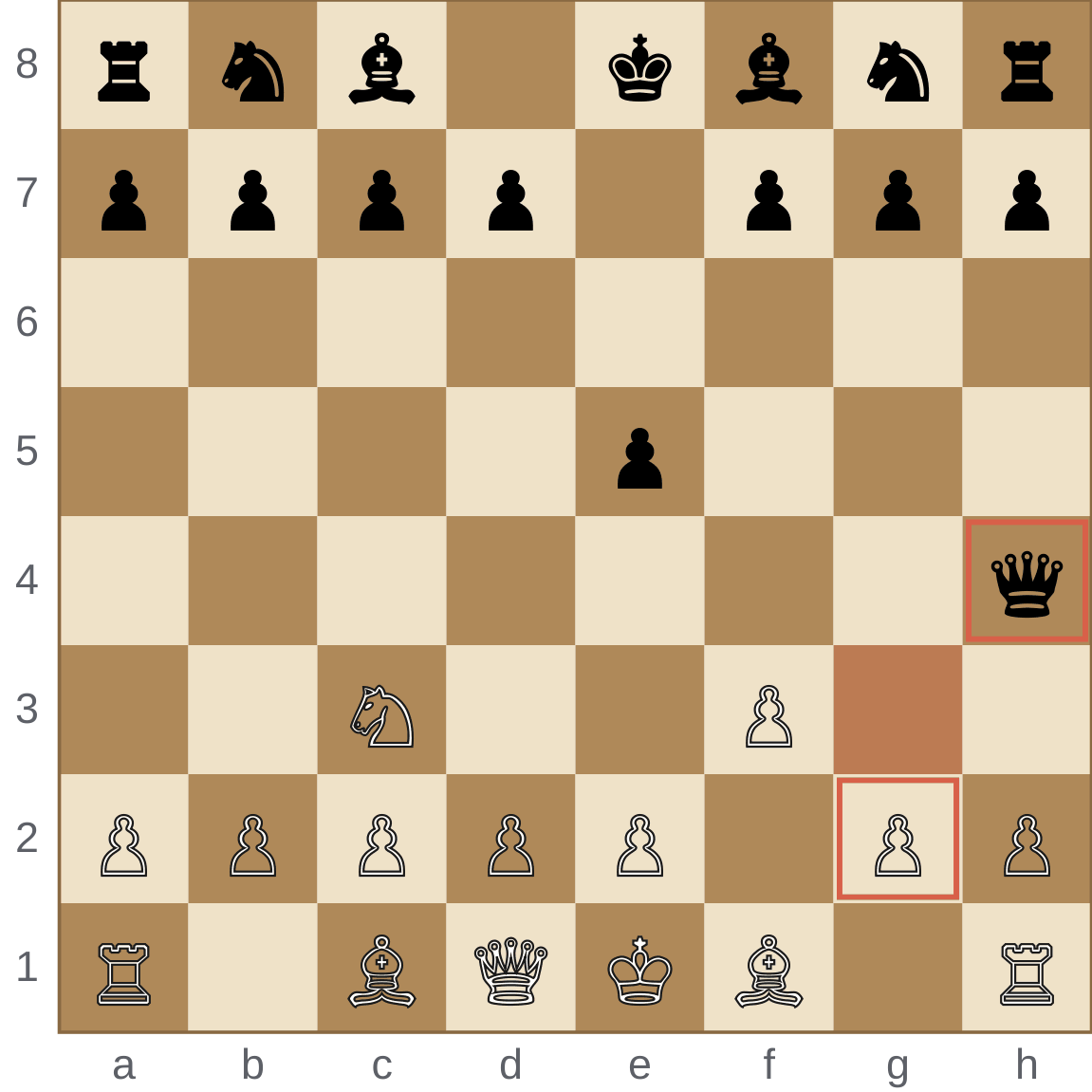
| White's pair | with …e5 | with …e6 |
|---|---|---|
| f3 & g4 | 1.f3 e5 2.g4 Qh4# | 1.f3 e6 2.g4 Qh4# |
| f4 & g4 | 1.f4 e5 2.g4 Qh4# | 1.f4 e6 2.g4 Qh4# |
| g4 & f3 | 1.g4 e5 2.f3 Qh4# | 1.g4 e6 2.f3 Qh4# |
| g4 & f4 | 1.g4 e5 2.f4 Qh4# | 1.g4 e6 2.f4 Qh4# |
The rule that separates them
There is a rule in chess that applies to a hand and cannot apply to a processor. In Hungarian chess usage it is the piesztus rule; in English it is the touch-move rule, Article 4 of the FIDE Laws of Chess. A player who deliberately touches one of his own pieces must move that piece, if it has a legal move. The one escape is to say j'adoube — “I adjust” — before touching it.
This binds a person. Barring a program written specifically to imitate it, it cannot bind a computer: the machine never touches, never grasps, never adjusts and never “marks” a piece for moving. It examines positions, compares them, and announces a move. The commitment a human makes with the fingers has no counterpart in the machine — and that is not cosmetic. It changes what “a random move” denotes, and therefore what the probability is.
Two ways of being random
Write K for the number of White pieces that have at least one legal move; piece i has mi legal moves of which gi are the move Black is hoping for, so its winning density is ρi = gi/mi.
Pmachine = (Σgi) / (Σmi) Pperson = (1/K) · Σρi
the machine averages the densities weighted by move count; the person averages them plainly
At move one the two models agree exactly: White has ten movable pieces — eight pawns and two knights — and every one of them has exactly two legal moves, so a weighted and a plain average coincide. The gap opens only at move two.
The numbers
Black's best reply is …e6, which is optimal against both opponents at once — convenient, since Fruzsi does not know which opponent she faces. After 1.f4, the alternative …e5 would offer the pawn and give White the extra legal move 2.fxe5, diluting the chance that White stumbles on 2.g4.
| White 1 | legal moves | movable pieces | machine | person |
|---|---|---|---|---|
| 1.f3 …e6 | 19 | 11 | 1/19 | 1/22 |
| 1.f4 …e6 | 20 | 11 | 1/20 | 1/22 |
| 1.g4 …e6 | 21 | 11 | 2/21 | 1/11 |
1/110 ≈ 0.9091 % · 1579/159600 ≈ 0.9893 %
the person, bound by the touch-move rule · the machine, bound by nothing
The difference is 1409/1755600, about 0.0803 percentage points — in relative terms the machine falls into Fruzsi's trap 8.83 % more often. It is the opposite of what one expects: a program choosing moves at random is a worse player, against this particular trap, than a child who has just learned the rules and chooses at random too. Not because the child understands anything, but because the child must commit to a piece before choosing a move, and that commitment — that hesitation of the hand — redistributes the probability.
The same gap in a hand of cards
Fruzsi now puts Jokers among the cards in her hand and offers Félix a second bet: that his chance of drawing a Joker is greater if she divides the cards and holds them in two hands. Three Jokers among twelve cards in one hand give 3/12 = 25 %. The same twelve cards split as ten with two Jokers and two with one give ½·(2/10) + ½·(1/2) = 35 %. Ten percentage points appear out of nothing: no card was added, removed or marked. Only the act of choosing changed, and the two-card hand is as likely to be picked as the ten-card hand.


The size of the gap, and its sign, depend on the totals, the hand sizes and how the Jokers are spread between them. Split the same twelve as eleven and one, with a single Joker alone in the small hand, and Félix's chance rises to 13/22 ≈ 59 %. Put all three in the big hand and it falls to 3/22 ≈ 14 %.
There is no chessboard in any of that. The touch-move rule only made the thing visible.
The arithmetic is old; the mechanism is not
A chooser that meets a piece with probability proportional to its number of moves is sampling in size-biased form, and the relation between a size-biased average and an ordinary one is standard — it is what makes the bus you board fuller than the average bus, because a full bus has more passengers available to be you. No priority is claimed for the algebra.
What is not standard is the mechanism. Size-biasing is usually an artefact of how a sample was drawn, a flaw to be corrected. Here it is neither artefact nor error: a rule written for human hands produces the unbiased sampler, and a processor, having no hands to bind, produces the size-biased one. Which of the two sits opposite is a fact about the opponent's body.
Why “the Rilke gap”?
Beyond the alliteration the Hungarian name offers — Rilke-rés — the reason is that Rainer Maria Rilke sets precisely these two things side by side: the machine that dares to feign spirit, and the hesitation of the human hand. The tenth sonnet of the second part of the Sonnets to Orpheus (1922) opens “Alles Erworbne bedroht die Maschine, solange / sie sich erdreistet, im Geist, statt im Gehorchen, zu sein” — all that is gained is threatened by the Machine, so long as it dares to be in spirit instead of in obedience — and sets against it der herrlichen Hand schöneres Zögern, the glorious hand's more beautiful hesitation. The sonnet gives the last word not to the Machine but to music, which builds its deified house out of trembling stones in useless space.
The Hungarian text of the paper was written from Rilke read in the Hungarian of Báthori Csaba, whose bilingual edition of the Szonettek Orfeuszhoz (Scolar, 2013) carries the translation, the preface and the biographical sketch. That translation is in copyright and is cited here, not reproduced; readers who want the Hungarian should go to the edition itself, where the German stands facing it.
Rilke's objection was not that the machine is weak. It was that the machine does not hesitate. The two probabilities above are the cost of that difference, priced in one particular trap. The hand that pauses over the piece is held by its pause; the machine, which pauses over nothing, is held by nothing — and walks in.
Magyarul
A teljes tanulmány kétnyelvű: a magyar változat a PDF második felében olvasható.
A kérdés az, mekkora esélye van annak, hogy a sötét bábokkal játszó Fruzsi megnyeri a Félixnek ajánlott fogadást, miszerint a játszma második lépésében már mattot ad. A válasz attól függ, hogy világos bábjait gép avagy ember vezeti. A piesztus-szabály (FIDE 4.1–9.) lépéskényszert jelent a megérintett bábbal — ez azonban a gépre nem vonatkoztatható, hiszen a gép soha nem érinti, nem fogja meg, nem igazítja a bábokat. Így az ember bábok, a gép pedig lépések között sorsol, és a két valószínűség elválik: 1/110 ≈ 0,9091 % az ember, 1579/159600 ≈ 0,9893 % a gép esetében. Meglepő módon a véletlenszerűen lépő gép 8,83 %-kal gyakrabban esik a csapdába, mint az így játszó ember.
Ugyanez a rés sakk nélkül is megjelenik: három Joker tizenkét, egy kézben tartott lap között 25 %-ot ad, de két Joker tíz lap között és egy Joker két lap között már 35 %-ot. A rés mérete és előjele függ a lapok és a Jokerek számától, a paklik méretétől és a Jokerek eloszlásától. A tanulmány megmutatja, hogy a két feladvány ugyanaz a tétel.
Related work
See also The Music Calendar, The Race Outcome Formula, Summetry, Hectoquads and the other papers.