RACE OUTCOME FORMULAVersenykimenetel képlet — bilingual edition
Eleven ways a two-horse race can end. 299 for four. Over 112 billion for twelve.
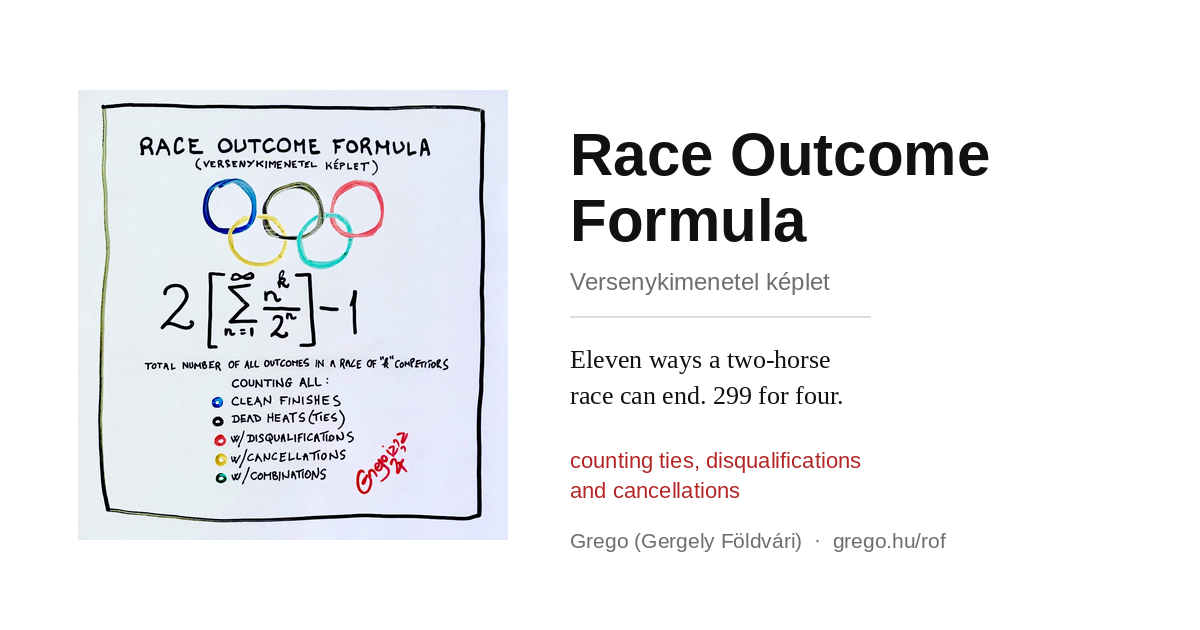
by Grego (Gergely Földvári)
The formula
For a race with k registered competitors, the total number of possible outcomes is
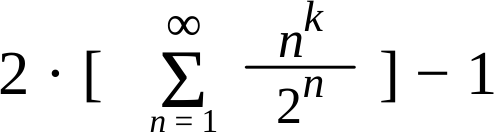
The bracket is an infinite sum but always closes on a whole number. For two competitors it gives 6, and the formula gives eleven. For three the bracket is exactly 26 and the formula gives 51.
| Competitors | 2 | 3 | 4 | 8 | 12 |
|---|---|---|---|---|---|
| clean finishes, k! | 2 | 6 | 24 | 40,320 | 479,001,600 |
| all outcomes | 11 | 51 | 299 | 2,183,339 | 112,366,270,379 |
The eleven, in full
Two competitors, A and B. Each may finish, and if both finish they may tie. Each may instead be disqualified after the start, or cancel before it. Writing f for finished, t for tied, d for disqualified and c for cancelled:
AfBf BfAf AtBt AfBd AfBc BfAd BfAc AdBd AcBc AdBc AcBd
Three outcomes if both finish. Four more where exactly one finishes. Four more again where neither does. Eleven.
What the sequence already was
These numbers were catalogued long before I met them, as A007047, under the description number of chains in the power set of an n-set. That phrase sounds forbidding and is not.
Take two things, A and B, and write down every selection you could make: nothing at all, just A, just B, or both. Four selections — the power set. Now stack them inside one another like nested boxes, each fitting within the next. A single selection counts as a stack of one. Such a stack is a chain. Count every chain you can build from two things and there are eleven; from three, 51; from four, 299.
Which is where the surprise lies. Eleven is also the number of ways a two-horse race can end. The two lists are the same length, and they are the same list.
The model, term by term
Splitting the count by how many competitors actually finish makes every part of the model visible:

Choose which j competitors finish — that is C(k, j). Rank them allowing ties — that is the Fubini number. Give each of the remaining k − j one of two fates, disqualified or cancelled — that is the power of two. Then add up over every possible number of finishers.
Why the distinction is the whole point
A cancellation happens before the start. Injury, illness, a ban, a missed flight. The competitor never crossed the line and left no trace in the race. A disqualification happens after it. The competitor ran — and something may have been achieved before the disqualification. A record split time may stand on the clock. A movement or a piece of conduct may matter to the athlete, to that race, to the inquiry that follows, or to the sport at large. The result is void; the event is not.
A rider disqualified for interference in the final furlong still rode the first six. A relay squad thrown out for a bad changeover still ran the legs.
The arithmetic makes the point more sharply than any argument. Counted with absence undifferentiated the outcomes run 1, 2, 6, 26, 150. With the distinction restored they run 1, 3, 11, 51, 299. Term for term, the second is exactly twice the first, less one.
The distinction does not refine the count. It doubles it.
And the doubling is the 2 standing in front of the bracket in the formula above, which has been carrying the argument on its face all along.
What is claimed, and what is not
Not claimed: the closed form is not new. Benoît Cloitre gave an equivalent formula on the Encyclopedia's entry in September 2002. The sequence is Sloane's and Nelsen's, and the chains reading goes back to Nelsen and Schmidt in 1991. Nor is the race reading of the Fubini numbers new.
Claimed: the interpretation, that A007047 counts the outcomes of a race; the model in which a non-finisher has two histories rather than one; the argument for why that distinction matters, drawn from what happens in sport rather than from the arithmetic; and the worked breakdown of the eleven, which makes the correspondence checkable by anyone.
The comment and example were accepted by the Online Encyclopedia of Integer Sequences on 28 July 2024, with the drawing linked from the entry. The paper is bilingual: the original Hungarian text of 10 July 2024 is printed in full.