MUSIC CALENDARThe major scale and the Hebrew leap-year cycle
The Hebrew calendar's seven leap years and the seven degrees of the major scale are the same seven numbers.
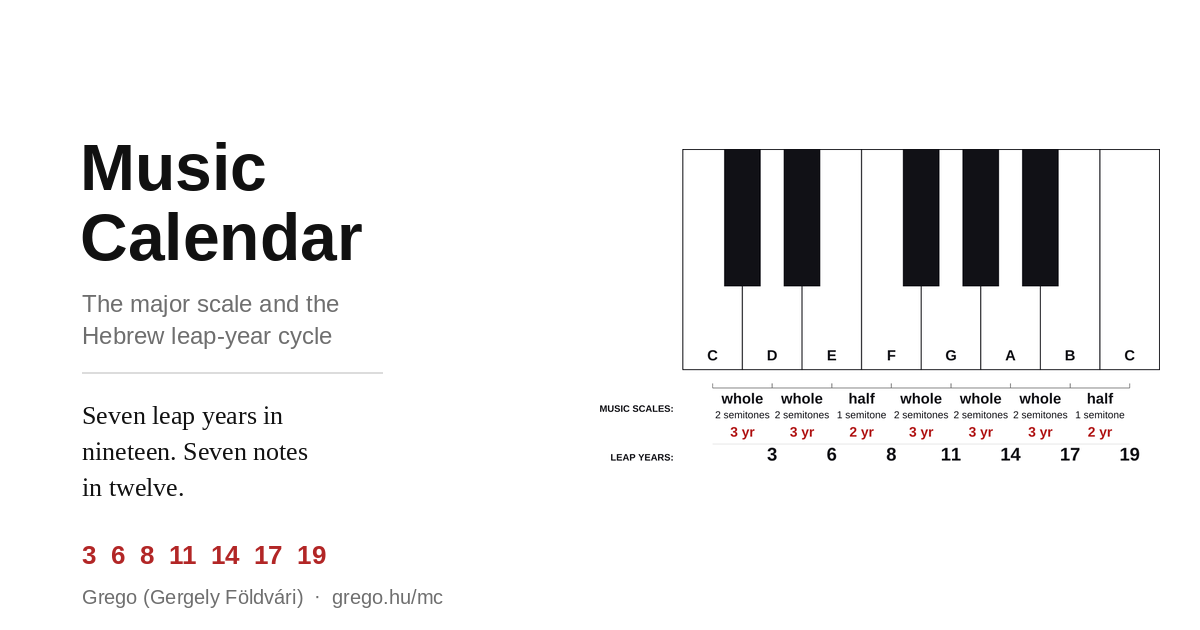
by Grego (Gergely Földvári)
The correspondence
The Hebrew calendar keeps the moon in step with the sun by inserting a thirteenth month, Adar II, in seven years out of every nineteen. The rule is arithmetical and fixed: the leap years fall at positions
3 6 8 11 14 17 19
The major scale takes seven notes from the twelve semitones of the octave, in the pattern of whole and half steps every musician knows. Now count differently — not the distance between notes but the notes themselves. A half step involves two, the one you leave and the one you reach. A whole step involves three, because a note lies between them. The running total is the whole of it.
| 1 | 2 | 3 | 4 | 5 | 6 | 7 | |
|---|---|---|---|---|---|---|---|
| step | whole | whole | half | whole | whole | whole | half |
| semitones | 2 | 2 | 1 | 2 | 2 | 2 | 1 |
| notes, or years | 3 | 3 | 2 | 3 | 3 | 3 | 2 |
| running total | 3 | 6 | 8 | 11 | 14 | 17 | 19 |
Why it happens
Both systems solve the same problem: place seven things around a cycle as evenly as the cycle allows. The calendar must fit seven leap years into nineteen; the scale must fit seven notes into twelve. Neither divides, so both need steps of two sizes with the two short ones as far apart as possible. This is maximal evenness, named by Clough and Douthett in 1991.
Seven into twelve leaves five. Seven into nineteen leaves five as well. So both need five long steps and two short, in the same order, and only the size of a step differs. That makes the correspondence a theorem rather than a coincidence.
The seven modes
The modes are not seven scales but one scale entered from seven positions — and each is equally a way of entering the nineteen-year cycle, which is to say a choice about which year you call the first.
| Mode | Semitone steps | Leap years |
|---|---|---|
| Ionian (major) | 2 2 1 2 2 2 1 | 3 6 8 11 14 17 19 |
| Dorian | 2 1 2 2 2 1 2 | 3 5 8 11 14 16 19 |
| Phrygian | 1 2 2 2 1 2 2 | 2 5 8 11 13 16 19 |
| Lydian | 2 2 2 1 2 2 1 | 3 6 9 11 14 17 19 |
| Mixolydian | 2 2 1 2 2 1 2 | 3 6 8 11 14 16 19 |
| Aeolian | 2 1 2 2 1 2 2 | 3 5 8 11 13 16 19 |
| Locrian | 1 2 2 1 2 2 2 | 2 5 8 10 13 16 19 |
The family, and nineteen-tone temperament
Any cycle leaving five when seven is taken out gives the same pattern. Those are the numbers 7k + 5 — 12, 19, 26, 33, 40 — and they are the equal temperaments in which the diatonic scale keeps its shape. Twelve-tone is the tuning of the piano. Nineteen-tone equal temperament is a real historical tuning, proposed by Salinas in 1577 and composed in by Blackwood.
In nineteen-tone the major scale has steps 3, 3, 2, 3, 3, 3, 2 and its degrees fall at 3, 6, 8, 11, 14, 17, 19. That is not an analogy to the leap years. It is the same list of integers.
The Hebrew leap-year cycle is the major scale in nineteen-tone equal temperament.
What is claimed, and what is not
Not claimed: that the framers of the calendar knew any music theory, or that musicians knew any calendar. There is no evidence of influence in either direction. Both traditions arrived at the same arrangement because they faced the same arithmetic, centuries and cultures apart. Nor is the diatonic scale universal; many traditions divide the octave quite differently.
The observation was first published on 19 February 2016 and entered the Online Encyclopedia of Integer Sequences as a comment on A057349 on 28 July 2024.