HECTOQUADSA new class of square dissections, with a smallest identified
Every element side between 1 and 100, both extremes present. Exactly eight perfect squared squares exist.
by Grego (Gergely Földvári)
The class
Diagnostic accuracy, test reliability, prevalence and incidence all arrive as rounded percentage points — whole numbers from 1 to 100. Nobody reports a specificity of 87.3164 per cent to a clinician; they report 87. Carrying that constraint into geometry gives a class of dissections.
A hectoquad is a squared square or squared rectangle in which every element side s satisfies 1 ≤ s ≤ 100, and in which both extreme values are present: it contains an element of side 1 and an element of side 100.
Both halves of that definition earn their place. The bound carries the percentage scale into the geometry; the two extremes carry a population holding someone who scored 1 and someone who scored 100. A dissection that meets the bound without reaching both ends is a half hectoquad if it reaches one, an inset hectoquad if it reaches neither.
The class is finite
The elements of a perfect dissection are distinct integers no greater than 100, so the most area one can enclose is the sum of the squares of all of them:
1² + 2² + … + 100² = 338,350
The side cannot exceed √338,350 = 581.68, and there are only a hundred integers to draw on, so the order cannot exceed 100. Side at most 581, order at most 100 — a closed and finite universe, which is what makes a census possible rather than a collection of examples.
The census
Every published catalogue of squared squares and squared rectangles was read and filtered. The results are counts, not estimates.
| Category | Hectoquad | Half | Inset | Summa |
|---|---|---|---|---|
| simple perfect squared squares | 8 | 63 | 29 | 100 |
| compound perfect squared squares | 0 | 1 | 0 | 1 |
| simple perfect squared rectangles | 142 | 2,922 | 2,649 | 5,713 |
| simple imperfect squared squares | 4,418 | 159,743 | 39,714 | 203,875 |
| simple imperfect squared rectangles | 417 | 22,642 | 15,421 | 38,480 |
| Total | 4,985 | 185,371 | 57,813 | 248,169 |
The perfect squared squares are the rarest of all, and by a long way. Orders 21 to 37 hold 27,940,214 of them and exactly eight are hectoquads — fewer than one in three million.
The rectangle rows reach past the published record. Perfect squared rectangles are catalogued openly only to order 21, but Stuart Anderson holds them further, and in September 2026 he ran this census over his orders 22 to 26 — 4,129,128,443 dissections. It returned 119 further hectoquads, about one in thirty-five million, every one verified here by rebuilding it from its code. The same run counted the wider classes for the first time outside the squares and found the same shape: 119 in the first class, 493 in the second, 831 in the third.
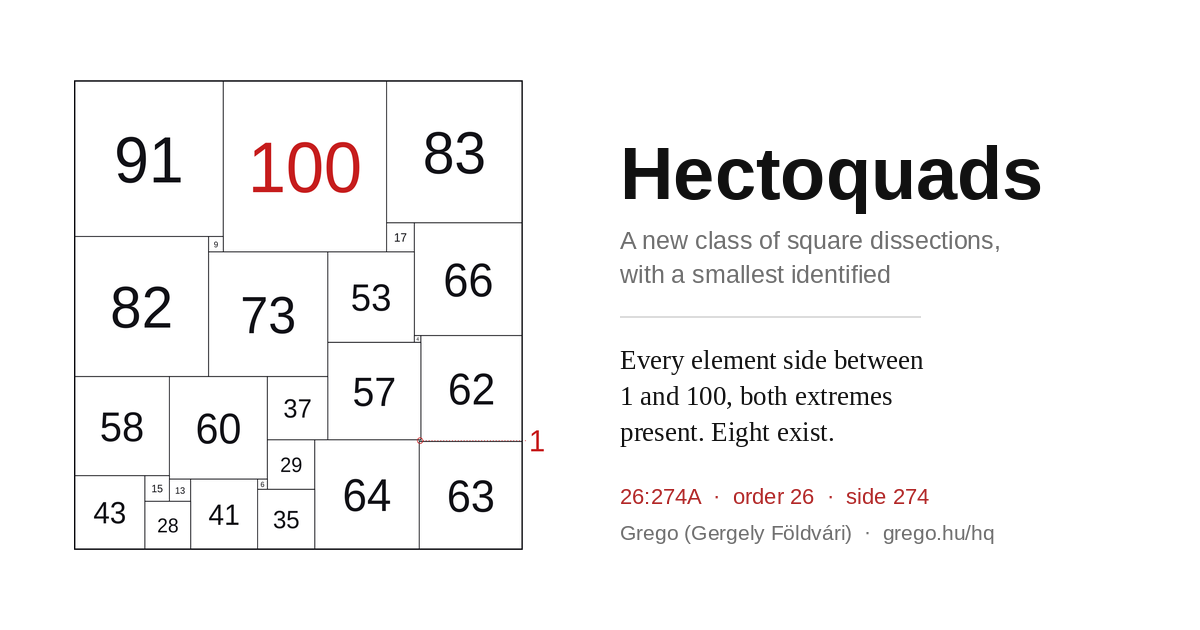
The smallest: 26:274A
Order 26, side 274, found by A. J. W. Duijvestijn in 1993. Its Bouwkamp code, reconstructed and verified here cell by cell — all 75,076 cells covered exactly once, no overlaps, no gaps:
26 274 274 (91,100,83) (17,66) (82,9) (73,53) (4,62) (57) (58,60,37) (29,64,1) (63) (43,15) (13,41,6) (35) (28)
Order 26 is minimal: orders 21 to 25 are enumerated in full — 1, 8, 12, 26 and 160 simple perfect squared squares — and none of the 207 is a hectoquad. Admitting imperfect and rectangular members lowers the floor rather than raising it: the smallest hectoquad of any kind is the order-11 rectangle 11:185×168A.
The eight
| Name | Order | Side | Mean | Median | Found by |
|---|---|---|---|---|---|
| 26:274A | 26 | 274 | 45.7692 | 44–52 | Duijvestijn, 1993 |
| 29:221A | 29 | 221 | 33.5517 | 29 | Anderson, Johnson, Pegg, 2011 |
| 29:264A | 29 | 264 | 38.2069 | 26 | Anderson, Johnson, Pegg, 2011 |
| 30:246A | 30 | 246 | 34.8667 | 27 | Skinner |
| 31:228B | 31 | 228 | 33.1613 | 29 | Williams, 2013 |
| 33:279A | 33 | 279 | 37.1818 | 27 | Williams, 2013 |
| 35:324A | 35 | 324 | 45.1429 | 42 | Williams, 2016 |
| 37:317D | 37 | 317 | 43.9730 | 38 | Williams, 2020 |
The problem it began with
A puzzle I posted on 14 June 2022, later set nationwide by the Joy of Thinking Foundation, backed by the Alfréd Rényi Institute of Mathematics. A mathematics teacher's pupils each score a different whole percentage; one scores 1 and one scores 100. They tile a chalk square on the yard with squares matching their scores. The Director will grant a pay raise only if a class reaches fifty in its statistically weighed overall score.
The mode fails — every score is different, so none exists. The mean is 45.77 and falls short. But with 26 pupils there is no middle pupil: the median is not a number but the interval 44 to 52, and fifty lies inside it. The teacher gets his raise.
The census shows the wording is exact. Four of its clauses cut the field in turn — 248,169 dissections inside the scale, 4,985 holding both extremes, 150 of those perfect, 8 of those square, and one reaching fifty. A quarter of a million enter and one leaves.
The data
The census is deposited with the paper as a CSV of 244,218 rows, one per dissection, carrying family, tier, order, dimensions, extremes, mean, the two middle scores and the element sides themselves. It is offered as the first half of an instrument: a searchable table matching real percentage distributions to drawable ones, in both directions. What remains is the module that queries it. Every hectoquad is listed; for the rectangle orders 22 to 26 the half and inset tiers were counted but not retained, so the file holds 3,951 fewer rows than the table above.
Acknowledgements
Special thanks to Stuart Errol Anderson of New Zealand, whose catalogues at squaring.net are the foundation on which this census rests, and who advised me to seek the full census in the first place. He rebuilt two truncated catalogue files within a day of their being reported, and in September 2026 he ran the census over his own unpublished orders 22 to 26 of the perfect squared rectangles — four billion dissections — which is where the 119 further hectoquads of version 1.1 come from. The work also stands on the enumerations of A. J. W. Duijvestijn, J. D. Skinner, James Williams, Lorenz Milla, Stephen Johnson and Ed Pegg Jr.